
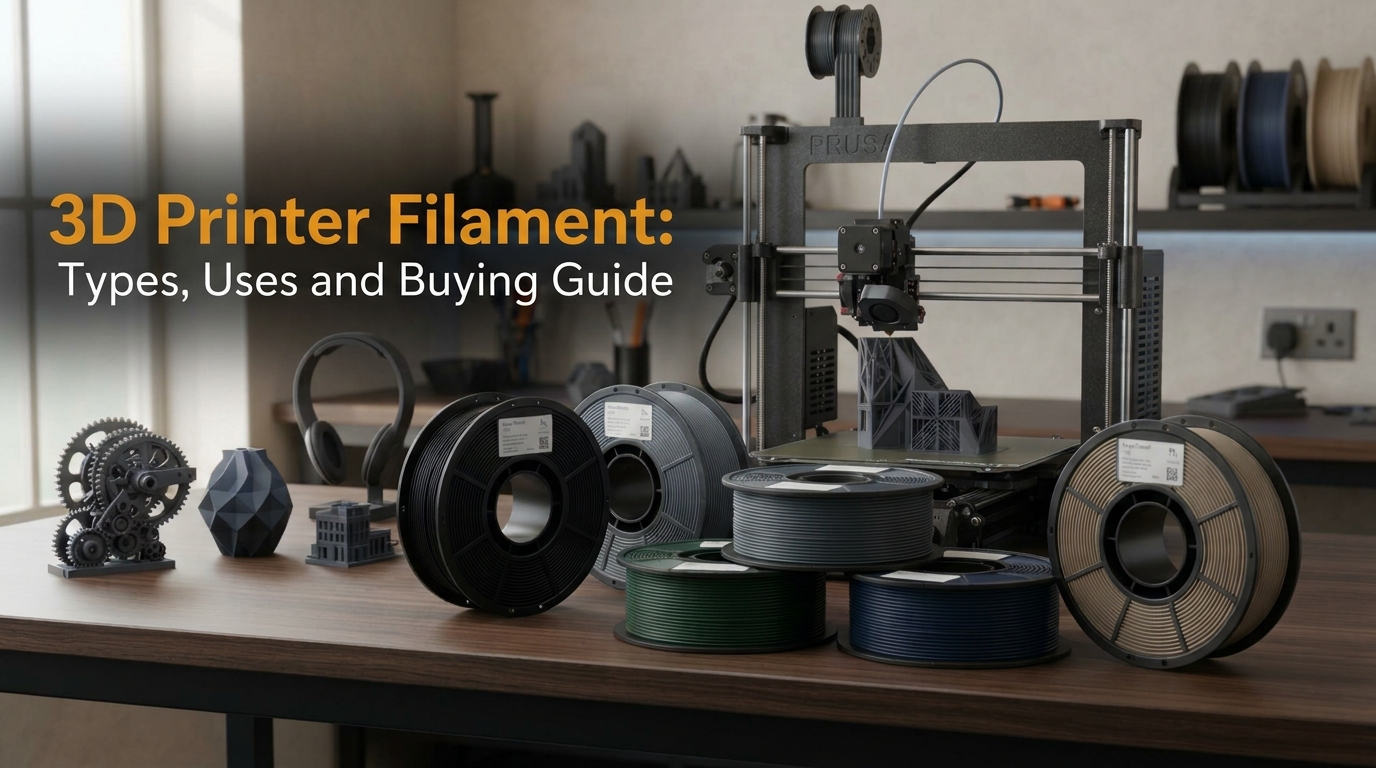
Choosing 3D printer filament is about more than picking a colour from a shelf. The material you feed into an FDM printer affects how a finished object looks, how it handles everyday use and whether it survives the conditions you have planned for it.
A decorative vase may need a clean surface and an attractive finish. A bracket or cable holder may need to tolerate repeated handling. And a small detailed figurine might be better made on a completely different type of printer.
This guide explains the main filament types, what to check before buying a spool and how to avoid common printing problems. It is also useful if you are ordering a custom print and want to understand why one material may be recommended over another.
What Is 3D Printer Filament and How Does It Work?
3D printer filament is a continuous strand of thermoplastic supplied on a spool. In fused deposition modelling (FDM), also called fused filament fabrication (FFF), the printer feeds that strand into a heated nozzle, melts it and places the material in thin layers to build an object.
Once deposited, each layer cools and bonds to the layer beneath it. The process makes it possible to create everything from desk organisers and display models to prototypes and selected functional components. However, a finished part’s performance depends on its design, print orientation and settings, not just the plastic itself.
Choosing 3D printer filament means weighing melting behaviour, flexibility, resistance to heat and surface appearance. That is why there is no universally best choice for every project.
Main Types of 3D Printer Filament
The most useful starting point is to match the material to the job. Below are the types most home users, hobbyists and small businesses are likely to encounter.
PLA Filament: A Practical Starting Point
PLA Filament (polylactic acid) is popular because it is relatively forgiving to print and offers a wide range of colours and finishes. It is often used for decorative objects, display models, signs, early prototypes and everyday indoor accessories.
PLA generally warps less than many engineering plastics, so it is a sensible first material if you are learning to print. It can create sharp details and appealing surfaces without the complexity of a high-temperature setup.
Its weakness is heat and repeated stress. Standard PLA can soften in warm conditions, and thin parts may snap rather than flex. A desk ornament may work beautifully in PLA, while a clip that must bend regularly could need something tougher.
For manufacturer-specific settings and limitations, consult Prusa’s PLA material guidance.
PETG: Better Toughness for Everyday Use
As a 3D printer filament for practical projects, PETG is often selected for organisers, tool holders, light-duty brackets and protective housings. Compared with standard PLA, it generally offers more toughness, better moisture resistance and improved tolerance of moderately warm conditions.
PETG is not perfect. It can produce fine strings between features, and the first layer can adhere very strongly to certain build surfaces. Good slicer settings and the right print sheet make a noticeable difference.
If you are deciding between the two materials for a particular object, our existing PLA vs PETG vs resin comparison explores their strengths and limitations in more detail.
TPU: Flexible Parts That Need to Bend
Thermoplastic polyurethane, usually called TPU, is used when a design needs elasticity. Common examples include protective sleeves, flexible feet, grips and some wearable accessories.
Not every flexible 3D printer filament behaves the same way. Its Shore hardness and formulation determine how soft it feels. Softer grades can be harder to feed through some extruders, especially at high printing speeds. Check that your printer supports the particular material before ordering.
ABS and ASA: For More Demanding Conditions
ABS and ASA are options for users who need greater heat resistance than standard PLA. ASA is also valued for its resistance to outdoor weathering and UV exposure, making it relevant to certain exterior parts.
This category of 3D printer filament generally needs more careful control of temperature and warping, often with an enclosure. Ventilation and manufacturer safety guidance matter, particularly when printing higher-temperature materials. These are not usually the easiest first spools for a beginner.
Composite and Decorative Filaments
Wood-effect, metallic-effect, glow-in-the-dark and fibre-filled options can change the appearance or properties of a print. Some are mainly decorative; others are intended for specialised engineering applications.
Be careful with abrasive additives. Carbon-filled and certain glow-in-the-dark materials can wear ordinary brass nozzles. As Prusa explains in its composite material guide, suitable wear-resistant hardware may be necessary.
3D Printer Filament Comparison at a Glance
| Material | Main benefit | Common applications | What to watch for |
|---|---|---|---|
| PLA | Easy printing and attractive finish | Décor, models, simple prototypes | Limited heat tolerance |
| PETG | Toughness and moisture resistance | Holders, brackets, organisers | Stringing and strong bed adhesion |
| TPU | Flexibility | Grips, feet, protective covers | Extruder compatibility and slower speeds |
| ABS | Heat resistance and durability | Selected technical parts | Warping, emissions and enclosure needs |
| ASA | Weather and UV resistance | Suitable outdoor components | Warping and ventilation requirements |
| Composites | Specialist appearance or properties | Display or technical applications | Abrasive fillers and hardware requirements |
This table is a guide rather than a guarantee. Properties vary between manufacturers, and the strength of a printed object is also affected by wall thickness, layer direction and how the part is used.
How to Choose the Right 3D Printer Filament
Before buying, consider the finished object rather than the spool’s appearance. The following checks can prevent wasted materials and disappointing prints.
1. Start With the Intended Use
A small nameplate, lamp ornament and workshop tool holder have different priorities. Decide whether appearance, impact resistance, flexibility, dimensional fit or heat tolerance matters most.
If the object will be exposed to sunlight, a hot car or repeated physical loads, ordinary PLA may not be the appropriate starting point. For a display piece kept indoors, paying more for a specialist filament may offer little practical benefit.
2. Check Diameter and Printer Compatibility
Most modern desktop FDM machines use 1.75 mm filament, but some systems use 2.85 mm. The wrong diameter can cause feeding problems or simply will not fit the machine. Prusa’s diameter glossary confirms the distinction.
For each 3D printer filament, also check the machine’s supported nozzle temperature, bed temperature, enclosure requirements and extruder design. A machine that prints PLA reliably may not be equipped to use a high-temperature engineering plastic or a very soft TPU.
3. Look Beyond the Price Per Spool
An inexpensive roll is not necessarily good value if inconsistent diameter, poor winding or moisture causes failed jobs. Look for clear material specifications, stated diameter tolerances, recommended printing settings and a supplier with dependable support.
A cheaper 3D printer filament can make sense for a quick concept model, while a more consistent grade may be worthwhile for a detailed piece or repeatable small-batch project. Compare overall reliability and waste, not just the initial purchase price.
4. Consider Colour, Finish and Surface Detail
Matte, silk and translucent finishes can give the same model very different appearances. These are often variations of familiar base polymers, so do not assume a decorative formulation has identical settings or mechanical properties to standard material.
Beyond your choice of 3D printer filament, layer height, nozzle size, model orientation and post-processing also affect appearance. For particularly intricate miniature features, the printing technology itself may matter more than selecting another filament colour.
What Printing Temperatures Should You Use?
There is no single temperature that works for every brand of 3D printer filament. The correct starting settings are the manufacturer’s recommendations on the spool, packaging or technical data sheet.
As a broad reference, PLA is commonly printed at lower nozzle temperatures than PETG, while ABS and ASA generally require hotter beds and more controlled print environments. Some speciality materials have additional requirements that standard desktop printers cannot meet.
Use a built-in slicer profile for your particular printer and material when available. Then make small, documented adjustments rather than changing several settings at once. For a wider technical reference, consult Prusa’s filament material guide.
Why Filament Storage Matters
Moisture is a frequent but overlooked reason for poor printing results. Many plastics absorb water from the surrounding air, although they do so at different rates. Once damp, a spool can contribute to popping sounds, stringing, rough surfaces or weaker-looking extrusion.
Store opened rolls in sealed containers or bags with suitable desiccant, and avoid leaving them in a humid room for long periods. Keeping the end of the strand secured also prevents tangles when you next load the spool.
If a material has absorbed moisture, use a suitable filament dryer and follow the supplier’s instructions. Drying temperatures that work for PETG or TPU may damage PLA. Prusa’s filament drying guide provides material-specific examples and cautions.
Proper storage helps 3D printer filament between projects and can reduce failures that are easily mistaken for a mechanical printer fault.
Common 3D Printer Filament Problems and Their Causes
Even a suitable material can print poorly if the machine, model or environment is not prepared for it. Several symptoms are worth recognising.
Stringing Between Features
Fine plastic threads can appear when the nozzle moves between separate parts of a model. Wet material, excessive temperature and poorly tuned retraction can all contribute. Begin by checking the spool’s condition and your printer’s recommended slicer profile.
Warping or Corners Lifting
If the edges of a print pull away from the bed, check first-layer adhesion, bed cleanliness, cooling and the material’s need for an enclosure. Larger ABS and ASA parts are especially sensitive to temperature changes.
Clogs and Under-Extrusion
A partly blocked nozzle, unsuitable temperature, worn drive gears or an inconsistent feed path can result in gaps and weak layers. Filled materials may require a larger or abrasion-resistant nozzle. Always follow your printer’s safe maintenance procedure before inspecting hot parts.
Parts That Break Too Easily
A part that fails under load may have been made from an unsuitable polymer, but the design can be equally important. Thin sections, poor layer orientation and insufficient walls can undermine an otherwise sensible material choice.
If the same fault keeps recurring, print a small test piece before committing to a large model. It is cheaper and easier to correct one variable at a time.
3D Printer Filament vs a Resin 3D Printer
A resin 3d printer does not use filament. Instead, it cures liquid photopolymer resin with controlled light. Resin printing is often chosen for small, intricate shapes and detailed surfaces, while filament-based printing is typically practical for larger objects and many everyday functional items.
That does not make one process automatically better. A decorative desk organiser may be economical in PLA, while a tiny detailed figurine may benefit from resin. Certain specialised resins also have useful engineering properties, but these depend on the formulation.
Resin requires its own handling precautions, washing and curing workflow. For practical safety guidance, see Formlabs’ resin printing safety FAQ.
When deciding between 3D printer filament and resin, focus on the geometry, desired finish, finished size and intended use rather than treating either material as universally superior.
Is 3D Printer Filament Environmentally Friendly?
The environmental impact of 3D printer filament deserves a closer look. PLA is often made from renewable plant-derived feedstocks, but that does not mean an ordinary print will break down in a garden or household compost bin.
Reducing unnecessary supports, choosing an appropriate infill percentage and avoiding repeat print failures can help limit waste. Keeping a spool dry and usable for longer is another practical step.
If sustainability is a priority, check whether the specific supplier offers verified recycled content or a suitable collection scheme. Avoid making assumptions based solely on green packaging or a broad biodegradable label.
When Should You Use a Professional 3D Printing Service?
You do not have to buy 3D printer filament, own a printer or learn every material setting to get a custom object made. For one-off gifts, replacement covers, prototypes or small production runs, it may be more straightforward to work with a service that can review the design first.
At PrintNests3D, we create selected custom 3D printed products for customers across the UK. Depending on the project, our material options include PLA, PETG and resin. We review the intended use, size and desired finish before discussing suitable production options.
If you already have a file, you can share an STL, OBJ or 3MF model. If you only have an idea or sketch, our custom designs page explains how to start an enquiry. You can also explore our UK 3D printing shop for ready-made products and inspiration.
For a project with specific requirements, request a custom 3D printing quote and tell us where and how the finished item will be used.
Frequently Asked Questions About 3D Printer Filament
What is the best filament for a beginner?
PLA is usually the most approachable starting point for a compatible FDM printer. It is relatively easy to print, widely available and suitable for many indoor models, decorative objects and prototypes.
How long does a spool of 3D printer filament last?
That depends on spool weight and the amount of material each model requires. A 1 kg spool can produce many small items or only a few large ones. Your slicer can estimate the grams needed before printing.
Can I use PLA Filament for outdoor parts?
PLA can work in certain sheltered, low-stress settings, but ordinary PLA is not usually the first choice for prolonged heat or sunlight exposure. PETG or an outdoor-oriented material such as ASA may be more suitable, depending on the design.
Can a resin 3d printer use filament?
No. Resin machines use liquid photopolymer materials, while FDM machines feed solid thermoplastic strand through a heated nozzle. The two consumables and printing processes are not interchangeable.
Does expensive filament always make better prints?
No. Reliable diameter, appropriate storage and consistent formulation matter, but correct slicer settings and a sound design are just as important. Choose a material that suits the object, not simply the highest-priced roll.
Final Thoughts: Choose Material for the Job
The right 3D printer filament should suit the object you are making, the printer you have and the environment in which the item will be used. PLA remains a useful option for decorative and straightforward indoor pieces. PETG adds toughness for many practical objects, while TPU, ASA and other specialist materials serve more specific needs.
Start with the purpose, confirm compatibility and keep the material in good condition. If you are planning a custom item rather than printing it yourself, talk to PrintNests3D about your design and let the intended use guide the material discussion.
Bring Your 3D Printing Ideas to Life with PrintNests3D!
ooking for high-quality, reliable 3D printing without the hassle of choosing materials or managing complicated printer settings? At PrintNests3D, we turn your ideas into professionally crafted 3D printed products with precision, durability, and attention to detail. Whether you need custom prototypes, personalised gifts, decorative models, or functional parts, we're here to help.
Get a Free Custom 3D Printing Quote and bring your next project to life!