
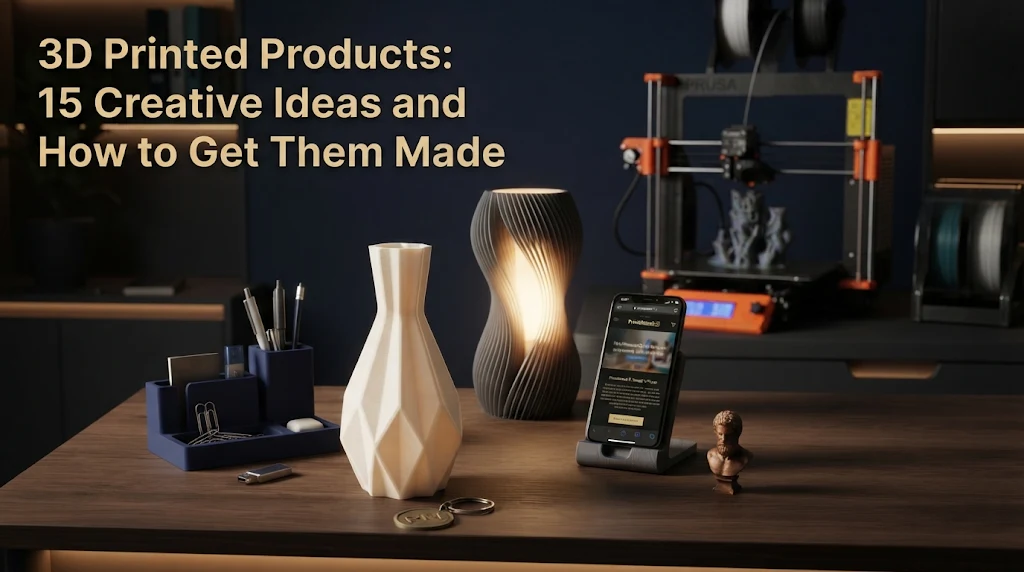
3D printed products are no longer limited to hobby projects and unusual plastic ornaments. Today, people use 3D printing to create personalised gifts, smart home accessories, decorative lighting, practical organisers and prototypes that may be difficult to find in a conventional shop.
The appeal is simple: instead of settling for a standard product, you can choose a shape, size, colour or detail that suits your particular space or purpose. A one-off 3D printed design can be just as interesting as a small batch made for a business or event.
In this guide, we explore 15 useful and creative ideas, explain how printing methods differ and show how a UK-based 3d printing service can help you turn an idea into a finished object.
What Are 3D Printed Products?
A 3D printed object begins with a digital three-dimensional model. A printer builds the design layer by layer, usually by depositing softened plastic filament or selectively curing liquid resin. This manufacturing approach is called additive manufacturing.
The result might be a decorative vase, a replacement knob, a miniature figure or a concept model for a new product. The important distinction is that a print can be adapted to an individual design without requiring the same tooling used in many traditional manufacturing processes.
That does not mean every idea should be printed. Very large items, high-volume identical parts and components subject to serious safety demands may be better suited to other manufacturing methods. For small, customised or experimental projects, however, the flexibility can be valuable.
For a broader explanation of the technology, see Formlabs’ introduction to 3D printing.
15 Creative 3D Printed Ideas for Homes, Gifts and Everyday Life
The best 3D printed project is often one that solves a specific problem or adds personality to a familiar object. These ideas range from simple decorative pieces to functional designs worth discussing with a printing specialist.
1. Personalised Nameplates and Door Signs
A 3D printed nameplate can include a person’s name, favourite colour, custom lettering or a simple logo. It works well for desks, bedroom doors, small business counters and special occasions.
For a polished result, consider where the sign will sit, how it will be mounted and whether raised letters or recessed details will look better.
2. Modern Vases and Decorative Planters
Geometric textures and sculptural silhouettes are especially well suited to layer-by-layer production. A 3D printed vase can complement a minimalist room, while a decorative planter cover can make an ordinary plant feel more distinctive.
Not every printed vase is watertight. If it will hold water or soil directly, confirm the material and any sealing requirements. A removable inner container is often a practical option.
3. Statement Lampshades and Ambient Lighting
Lighting is an opportunity to create organic shapes, patterned surfaces and subtle textures that cast interesting shadows. A custom shade can coordinate with the size and style of a particular room.
Only use a design, light source and electrical fittings that are appropriate for the material’s heat tolerance. Never assume an ordinary plastic lampshade is suitable for any bulb or electrical assembly.
4. Desk Organisers and Pen Holders
A 3D printed desk organiser can be designed around the items you actually use, rather than the compartments provided by a mass-produced product. Pens, notes, USB drives and small stationery can each have a designated space.
For a more tailored workstation, measure your desk area and the objects that need to fit before choosing a design.
5. Headset and Controller Stands
Gaming and work-from-home setups benefit from stands that keep accessories off crowded surfaces. A headset holder can be designed to fit a desk corner, while a controller cradle can match the shape and size of the device.
Pay attention to balance, cable clearance and the contact points that support the equipment. A good-looking model is only useful if it remains stable in daily use.
6. Cable Clips and Cord Winders
Small organisational accessories are among the most practical 3D printed products. Cable guides, labelled clips and cord winders can tidy workstations, bedside tables and entertainment units.
For clips that must repeatedly flex, material choice matters. A rigid design may perform differently from one developed for a more flexible polymer.
7. Phone and Tablet Stands
A custom phone stand can include a charging-cable opening, a chosen viewing angle and a base sized for a particular desk. Tablet stands may need extra support because of the device’s greater weight.
Check the dimensions with the device and case attached. Even a few millimetres can affect whether a product fits properly.
8. Personalised Keyrings and Bag Tags
Names, initials, icons and small decorative shapes can turn an everyday accessory into a thoughtful present. A 3D printed keyring is also an accessible idea for club events, party favours and personal branding.
For durability, avoid extremely thin lettering around the attachment hole and confirm the finish will withstand normal handling.
9. Textured Wall Art
Layered patterns, abstract geometry and three-dimensional reliefs can add depth to a blank wall. You can use a single statement piece or arrange several smaller elements into a coordinated display.
A 3D printed artwork can be designed to match existing décor, but installation still needs suitable fixings for the wall and the object’s weight.
10. Board Game Inserts and Hobby Storage
Custom trays can separate cards, tokens, miniatures and other small components. This is particularly useful when the original box offers little organisation or when a collection grows over time.
Accurate measurements are important. Leave appropriate clearance so the pieces can be picked up easily without becoming loose in transit.
11. Miniatures, Models and Collectable Displays
Small figurines and intricate display models can benefit from the fine detail achieved with a resin 3d printer. Resin printing uses light to cure liquid photopolymer instead of pushing filament through a heated nozzle.
A finished miniature may still require support removal, washing, curing and finishing. If you plan to paint it, ask whether the surface and resin type suit the desired result.
12. Replacement Knobs and Non-Critical Covers
When a cupboard knob, small cover or decorative housing goes missing, a made-to-measure replacement may be possible. The value comes from recreating an uncommon shape or dimensions that are not easily available off the shelf.
Do not substitute a 3D printed part into a safety-critical, load-bearing, heat-sensitive or electrically protective application without competent engineering assessment and appropriate testing.
13. Under-Shelf Hooks and Small Storage Accessories
A small hook or clip can make otherwise unused space more convenient. Under-shelf organisers and lightweight holders can be customised for a particular shelf thickness or object.
Check the likely load, fixing method and material. Printed hooks are not automatically suitable for heavy equipment or repeated high-stress use.
14. Product Prototypes for Startups
A prototype helps a team see and handle a design before investing in production tooling. A 3D printed model can reveal awkward proportions, poor ergonomics or assembly conflicts that may not be obvious on a screen.
Early versions are often intended to test shape or fit rather than prove long-term performance. Iterating on a small prototype can be more useful than trying to make the first version perfect.
15. Personalised Gifts and Event Keepsakes
Custom ornaments, small table decorations, commemorative plaques and personalised keepsakes can be created for birthdays, weddings and business events. These projects work best when the message or design feels specific to the recipient.
A 3D printed gift does not need to be elaborate. A thoughtful, well-finished object in the right colour and size can make a stronger impression than an oversized novelty.
If you want inspiration from products already offered in Britain, explore the PrintNests3D collection, which includes décor, lighting, keyrings and practical home accessories.
Which Materials Work Best for Different Projects?
A product’s appearance does not tell you everything about its durability. Material, wall thickness, print direction, geometry and exposure conditions all influence how it performs.
| Material | Often suitable for | Important consideration |
|---|---|---|
| PLA | Indoor décor, nameplates and presentation models | Limited resistance to high heat |
| PETG | Selected holders, organisers and practical accessories | Print quality and stiffness vary by design |
| TPU | Flexible grips, feet and protective accessories | Softness and printer compatibility vary |
| Standard resin | Fine-detail figures and ornamental miniatures | Handling, washing and curing requirements |
| Speciality engineering materials | Certain technical parts | Require project-specific assessment and equipment |
For many 3D printed home accessories, PLA offers a useful combination of appearance and affordability. PETG may be worth considering for objects that face more frequent handling. Resin can be helpful where small details and smooth surfaces are the priorities.
Choosing between these options is not simply about which plastic is strongest. A large object might benefit from one technology, while a small sculpted model benefits from another. Our PLA vs PETG vs resin guide explains the practical differences in greater detail.
Should You Buy the Best 3D Printer or Use a Printing Service?
If you frequently design new objects, enjoy learning technical skills and want to experiment, owning a printer can be rewarding. But the best 3d printer for a beginner’s desk is not necessarily the right machine for miniature figurines or demanding prototypes.
A filament printer generally suits many everyday objects, larger decorative shapes and basic functional pieces. A resin 3d printer may be preferable when very fine features or smooth miniature surfaces matter most. Resin also introduces additional handling, ventilation, washing and curing responsibilities.
For an independent overview of these differences, read Prusa’s printer selection guide and Formlabs’ comparison of FDM and SLA printing.
If your goal is one gift, a single replacement component or a short run of products, a 3d printing service can remove the need to purchase equipment and learn a production workflow. That is especially helpful when you are unsure about materials, print orientation or finishing.
Printer Ownership vs Professional Printing
| Factor | Owning a printer | Using a printing service |
|---|---|---|
| Upfront cost | Machine, tools and materials | Usually project-based pricing |
| Learning | You manage setup and troubleshooting | Production handled by the provider |
| Repeated experimentation | Convenient when equipment is ready | Requires separate job planning |
| Materials and finishing | Limited by your setup | Depends on the provider’s capabilities |
| One-off orders | May be costly if equipment is rarely used | Can be practical for occasional projects |
The best choice depends on how often you print, how much control you want and whether operating the equipment is part of the hobby.
How to Order a Custom 3D Printed Item in the UK
For a 3D printed order, you do not necessarily need design software or a finished technical drawing. A clear brief and a few useful measurements can be enough to start discussing feasibility with a 3d printing service.
Step 1: Explain What You Want to Make
Describe the object, where it will be used and what problem it should solve. Include a reference photograph or rough sketch if you have one. If your project must fit around another item, share those measurements too.
Step 2: Send a File if You Have One
STL, OBJ and 3MF are commonly used for print enquiries. If you already have a model, identify any areas where exact dimensions, surface detail or movement matter. Otherwise, ask whether the design can be developed from your idea.
Step 3: Discuss Material and Finish
Tell the provider whether appearance, flexibility, detail or everyday toughness is the priority. For a 3D printed decorative item, colour and texture may dominate the decision. For a prototype, the fit and purpose may be more important.
Step 4: Confirm Quantity, Price and Timing
A single item and a batch of 30 require different planning. Ask what is included in the quote, whether finishing or design preparation is required, and how delivery will be arranged. Confirm deadlines before approving the order.
Step 5: Approve Production and Delivery
Review the scope and dimensions before work begins. A sensible provider will identify obvious uncertainties rather than assume that a reference image contains all the necessary details.
PrintNests3D accepts enquiries using files, sketches and descriptions through its custom 3D printing page. You can also view examples of custom designs before submitting your own concept.
What Affects the Price of 3D Printed Products?
Two similarly sized objects may cost different amounts because their geometry and finishing requirements are different. An intricate model with many supports is not always as straightforward as a simple geometric container.
Consider these main factors:
- Object dimensions: Larger pieces often require more material and machine time.
- Design complexity: Thin features, challenging angles and detailed surfaces can increase preparation.
- Chosen material: Standard filament and specialist resins have different costs and workflows.
- Finish: Sanding, painting, assembly or other finishing adds work.
- Quantity: Small-batch pricing depends on setup and efficient use of equipment.
- Delivery: Packaging and shipping requirements vary with size and fragility.
When comparing quotes for 3D printed work, ask what standard of finish and what level of design preparation is included. The cheapest headline price may not cover the same deliverables.
Common Mistakes to Avoid Before Ordering
One of the most frequent mistakes is choosing a design only because it looks attractive online. A model may need modifications to fit the intended space or use. Another common problem is overlooking the tolerance needed for parts that slide together or fit around an existing object.
Material assumptions can also lead to disappointment. An object made for indoor display should not automatically be expected to survive direct sunlight, high temperatures or heavy loads. Similarly, a printed container should not be assumed food-safe or watertight without appropriate verification.
Finally, avoid sending only a low-resolution picture when exact dimensions matter. Include measurements, intended use, colour preference and any fixed requirements. That information helps a 3d printing service assess your project more accurately.
Frequently Asked Questions
Are 3D printed products strong enough for everyday use?
Some are, depending on material, design, print settings and the type of stress involved. Desk organisers and decorative accessories have different requirements from structural or safety-critical components. Discuss the actual load and environment before ordering a functional part.
Can I order a custom design without a 3D model?
Yes. Many providers can review a sketch, measurements and a written brief before explaining what design work may be necessary. PrintNests3D accepts custom project enquiries without requiring a complete model at the outset.
What is the best 3d printer for making home accessories?
There is no universal answer. A reliable FDM machine can be a practical choice for many home accessories, but size, materials, budget, safety features and how frequently you will print all matter. For one-off projects, outsourcing can be more convenient than buying equipment.
Is a resin 3d printer better than a filament printer?
Not for every job. Resin can reproduce fine detail and smooth surfaces, while filament printing is often practical for larger everyday objects. A resin workflow also requires appropriate safety precautions and post-processing; see Formlabs’ resin safety guidance.
How long does a custom 3D printed order take?
Timing depends on the design, size, number of pieces, material, finishing and the provider’s workload. Ask for a project-specific estimate and make any event deadline clear before approving the order.
Can 3D printed objects be personalised?
Yes. Names, initials, dimensions, shapes and colours can often be changed on 3D printed products, subject to the design and manufacturing limits. This makes personalisation especially appealing for gifts, signs and decorative items.
Final Thoughts: Create Something That Fits Your Idea
The most useful 3D printed products balance creativity with the practical needs of the person using them. You might want a decorative object that complements your home, a personalised gift with a memorable detail or a prototype that helps test a new business concept.
Start with the purpose, provide accurate measurements and choose the material and printing process around the intended use. When you are not sure how to proceed, professional guidance can help turn a rough concept into a realistic plan.
Bring Your Idea to Life With PrintNests3D
Have a 3D printed product in mind but do not know where to start? PrintNests3D helps UK customers create personalised gifts, home accessories, prototypes and suitable one-off or small-batch projects. Share a sketch, image or digital model, and our team will review what is practical before you commit.
Get a Free Custom 3D Printing Quote and take the next step towards a product made for your needs.
Have something in mind you'd love to bring to life?
Share your concept, model or requirements with PrintNests3D and explore the possibilities of bespoke 3D printing.
Explore custom designs