
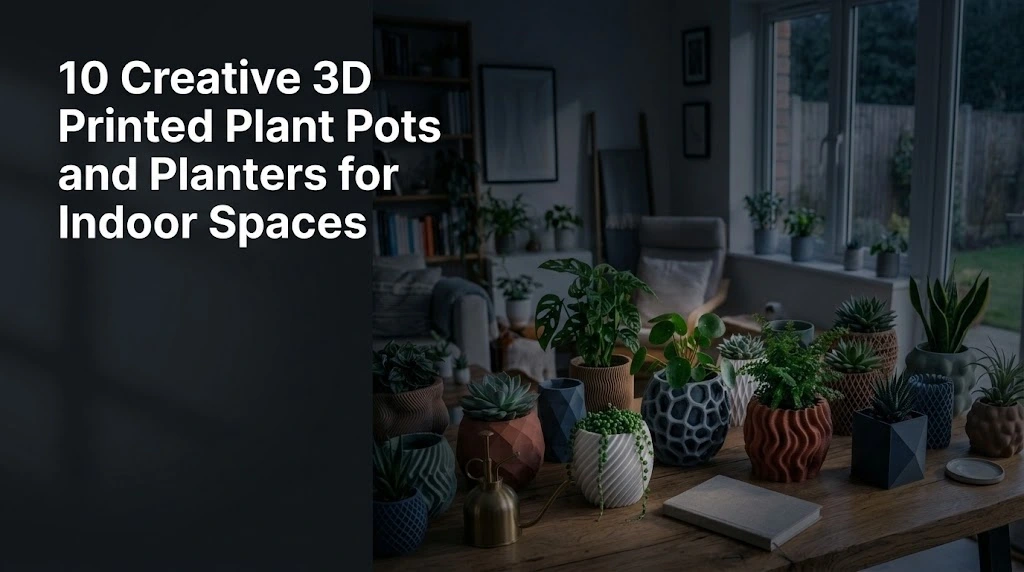
10 Creative 3D Printed Plant Pots and Planters for Indoor Spaces
Indoor plants can make even the simplest room feel more welcoming. Whether you have a small succulent on your desk or a collection of leafy plants in your living room, the right planter can make a noticeable difference.
Traditional ceramic and plastic pots are practical, but they don’t always offer the shapes, textures or personalised details you might want.
That’s where 3D printed plant pots offer something different.
From geometric containers to sculptural designs, 3D printing makes it possible to create interesting planters that complement modern interiors without taking up unnecessary space.
At PrintNests3D, we create 3D printed products for customers across the UK, including decorative accessories and custom designs.
In this guide, we’ll explore ten creative 3D printed plant pots, discuss which styles suit different indoor plants and explain what to check before choosing a planter for your home.
Why Choose 3D Printed Plant Pots for Your Home?
Not every plant needs an elaborate container. Sometimes, however, a distinctive planter can turn an ordinary houseplant into an attractive feature.
One advantage of 3D printing is the freedom it offers when creating shapes and surface details.
Designers can produce ribbed textures, curved surfaces and geometric patterns that would be difficult or costly to manufacture using some traditional methods.
3D printed plant pots can offer several practical and decorative benefits:
- Distinctive designs: Explore modern, geometric and sculptural styles.
- Customisation: Suitable designs can be adjusted to particular dimensions or colour preferences.
- Compact options: Small planters can fit desks, windowsills and narrow shelves.
- Coordinated styling: Matching designs can create a consistent appearance across different rooms.
- UK-made alternatives: Buying from a UK-based printing service makes it easier to discuss individual requirements.
However, appearance shouldn’t be your only consideration. Drainage, material suitability, size and moisture exposure all matter when choosing containers for living plants.
10 Creative 3D Printed Plant Pots and Planters
1. Geometric Plant Pots for Modern Interiors
Geometric planters are a natural choice for contemporary homes.
Their angular surfaces, repeating patterns and clean edges introduce visual interest without requiring bright colours.
Hexagonal, faceted and polygon-inspired 3D printed plant pots can complement modern furniture, particularly in rooms with simple layouts and neutral walls.
For example, a white geometric pot holding a green succulent can look attractive on a wooden shelf or home office desk.
If you prefer a more dramatic effect, consider dark grey or black.
Best for: Succulents, small foliage plants and minimalist interiors.
Styling tip: Pair an angular pot with rounded furniture or softer decorative objects to create contrast.
2. Ribbed Planters for a Minimalist Look
Ribbed plant pots feature repeated vertical or curved lines that give their surfaces a subtle texture.
These designs work particularly well in Scandinavian-inspired interiors, where simple colours and natural materials often take priority.
Cream, beige and muted grey planters can complement light wooden furniture without making a room look too busy.
Small ribbed pots also work nicely when grouped together.
You could arrange three containers of different heights on a windowsill, provided each plant receives suitable light.
Ribbed 3D printed plant pots can also be designed as decorative outer covers for existing nursery pots.
Best for: Peace lilies, compact foliage plants and coordinated plant displays.
3. Spiral and Twisted Plant Pots
A spiral planter makes the container part of the decoration.
Instead of straight sides, the design incorporates twisting lines or flowing curves that create movement around the plant.
These sculptural shapes can look particularly striking when paired with simple greenery.
A twisted planter holding a compact succulent, for example, can become a small statement piece on a bookshelf.
The contrast between the plant’s natural shape and the container’s structured surface makes the arrangement interesting.
Spiral designs also suit side tables and hallway consoles where a single decorative object has room to stand out.
Choose a stable base and check that the container has enough internal space for the plant.
Best for: Small statement plants and decorative indoor arrangements.
4. Mini 3D Printed Plant Pots for Succulents
Not every home has space for large planters.
If you live in a compact UK flat or want to add greenery to your desk, miniature pots can be a practical choice.
Small 3D printed plant pots are particularly suitable for creating decorative displays with appropriately sized succulents.
You could arrange two or three miniature containers along a shelf or place a single plant beside your computer monitor.
The key is choosing the correct size.
A container that’s too small can restrict root growth, while a pot that’s unnecessarily large may retain more moisture than the plant needs.
Succulents generally require free-draining growing media and careful watering.
For these plants, drainage should take priority over appearance.
Best for: Small succulents, miniature plants and limited desk space.
5. Hanging Planters for Small Rooms
When floor and shelf space is limited, hanging plants provide another way to introduce greenery.
Hanging 3D printed plant pots can be designed with decorative patterns, curved shapes or carefully positioned attachment points.
They may be attractive for trailing plants such as pothos.
However, hanging planters require additional attention to safety.
The container, growing medium and watered plant all contribute to the total weight.
Any supporting cord, bracket or fixing must be suitable for that load.
For a custom-printed hanging planter, the design and attachment method should be assessed before use.
Avoid assuming that a decorative 3D printed container is automatically suitable for suspension.
Best for: Trailing indoor plants and spaces with limited surfaces.
6. Self-Watering Planters for Convenient Plant Care
Self-watering containers can help make routine plant care more convenient when their watering system suits the plant.
These designs generally use a separate water reservoir and a mechanism that transfers moisture towards the growing medium.
Some 3D printed plant pots can incorporate reservoirs, removable inserts or other functional elements.
However, successful operation depends on the design, material, plant type and watering arrangement.
Not every houseplant benefits from constantly available moisture.
Plants that prefer their growing medium to dry between waterings may need a different approach.
If you’re considering a custom self-watering planter, ask how the reservoir works, how it can be cleaned and whether the printed components are suitable for repeated water exposure.
Best for: Suitable moisture-loving houseplants and households seeking a more structured watering routine.
7. Wall-Mounted Plant Pots for Vertical Greenery
Wall-mounted planters offer a creative way to use vertical space.
They can be especially useful in smaller homes where shelves and furniture already occupy most available surfaces.
A series of compact wall planters can create an attractive botanical arrangement in a living room or home office.
Geometric designs work particularly well because they can be arranged into coordinated patterns.
Before choosing wall-mounted 3D printed plant pots, consider the overall weight, mounting hardware and watering arrangements.
Water must not be allowed to damage the wall, and the mounting system must support the planter safely.
A removable nursery pot inside a decorative wall-mounted holder may make watering and maintenance easier.
Best for: Small trailing plants, vertical displays and decorative feature walls.
8. Nature-Inspired Plant Pots with Organic Shapes
Not everyone wants sharp geometric lines.
If your interior features natural wood, soft fabrics and earthy colours, plant pots with organic shapes may feel more appropriate.
These designs can take inspiration from leaves, stones, waves and other natural forms.
Curved 3D printed plant pots can create a softer appearance while still offering the distinctive textures associated with additive manufacturing.
Muted green, cream and terracotta-inspired colours can complement botanical displays.
Nature-inspired designs also work well alongside decorative vases and sculptural accessories.
For more ideas on combining these elements, explore our guide to 3D printed home décor ideas.
Best for: Nature-inspired rooms, warm neutral interiors and decorative plant collections.
9. Modular Plant Pots for Flexible Arrangements
Modular planters are designed as separate components that can be arranged together.
For example, a collection might include several small containers that fit into a shared display tray or connect through a suitable supporting structure.
This approach can be useful if you enjoy changing your indoor plant arrangements.
You could start with two small plants and expand the display as your collection grows.
Modular 3D printed plant pots can also create an organised appearance on larger windowsills or shelving units.
When choosing a modular system, check whether individual containers can be removed for watering and cleaning.
Each plant should have sufficient space, appropriate drainage and access to suitable light.
Best for: Plant collections, coordinated displays and flexible shelf arrangements.
10. Personalised 3D Printed Plant Pots
Sometimes, the best planter is one created around a particular space or idea.
Personalised designs might include a preferred colour, custom lettering, decorative patterns or dimensions suited to an existing nursery pot.
For example, you might want a compact planter cover that fits neatly into a narrow windowsill.
Alternatively, a personalised plant pot could become a thoughtful housewarming present.
Custom 3D printed plant pots may also be useful when standard shop-bought sizes don’t suit your requirements.
At PrintNests3D, we offer a custom 3D printing service in the UK where customers can submit design files, sketches or project descriptions for review.
If you have a planter idea, our team can assess the proposed dimensions, materials and intended use before confirming whether production is practical.
Best for: Personalised gifts, unusual spaces and bespoke home accessories.
How to Choose the Right 3D Printed Plant Pots
A beautiful container isn’t necessarily the right container for every plant.
Before purchasing, consider how the planter will work in everyday use.
Check the Size and Root Space
Start by measuring your plant’s existing nursery pot.
Check its top diameter, base width and height before choosing an outer planter.
If you’re buying a decorative cover, ensure there’s enough space to insert and remove the nursery pot comfortably.
If you’re repotting directly into a new container, choose a size appropriate to the plant’s root system rather than automatically selecting a much larger pot.
The Royal Horticultural Society’s repotting guide explains how root growth, drainage and growing conditions influence repotting decisions.
Understand Drainage Requirements
Drainage is one of the most important features of functional plant pots.
When watering, excess moisture needs somewhere to go.
If a container has no drainage hole, it is usually better to treat it as a decorative outer pot and keep the plant in a separate inner container with suitable drainage.
Remove any collected water after watering.
Some 3D printed plant pots can include drainage holes and matching saucers, but their suitability depends on the actual design.
Never assume a printed planter is watertight simply because it looks solid.
Choose a Suitable Material
Common 3D printing materials include PLA, PETG and resin.
Each has different characteristics, and the finished item’s suitability depends on more than material choice alone.
For example, a PLA planter may work well as an indoor decorative cover, but heat and prolonged direct sunlight can affect some PLA prints.
Similarly, PETG may offer advantages in certain applications, but that doesn’t guarantee a watertight finished object.
Layer construction, wall thickness, surface finish and intended use all matter.
Always confirm whether a planter is intended for direct soil contact or for use with a separate nursery pot.
Styling 3D Printed Planters in Different Rooms
You can use 3D printed plant pots throughout your home, but each location brings different practical requirements.
| Location | Recommended style | What to consider |
|---|---|---|
| Living room | Sculptural or ribbed planters | Size, stability and available light |
| Home office | Mini geometric pots | Compact dimensions and desk protection |
| Bedroom | Neutral, nature-inspired pots | Plant suitability and easy maintenance |
| Windowsill | Small decorative planters | Sun exposure and temperature changes |
| Shelving unit | Modular or miniature pots | Weight, drainage and accessibility |
For a balanced arrangement, try combining containers of different heights while keeping the colours reasonably consistent.
You don’t need to fill every shelf with greenery.
One carefully chosen plant can be just as effective as a large collection.
How to Clean and Maintain 3D Printed Plant Pots
Routine cleaning helps decorative planters retain their appearance.
Most suitable non-electrical printed accessories can be dusted using a soft cloth or gentle brush.
For light marks, a slightly damp cloth may be appropriate if the material and finish permit it.
Avoid abrasive scrubbers, harsh cleaning products and exposure to excessive heat.
If using a printed decorative cover, remove the inner nursery pot when watering and check for collected moisture.
Do not put printed planters in a dishwasher unless the manufacturer explicitly confirms this is safe.
If a planter develops cracks, warping or other signs of damage, reassess whether it can safely continue supporting the plant.
Why Choose PrintNests3D for Custom Plant Pot Designs?
Finding a planter that matches your furniture, available space and preferred colour isn’t always easy.
At PrintNests3D, we manufacture 3D printed products in the UK and offer bespoke printing for suitable customer projects.
Our custom design service gives you an opportunity to explore whether a particular planter concept can be manufactured.
You can provide an existing 3D model or share a sketch, reference image or description of what you’d like to create.
We can review the intended dimensions, suitable materials and practical considerations before discussing the next steps.
You can also browse our online shop for currently available decorative accessories and other 3D printed products.
For planter requests, it’s important to explain whether the design will hold soil directly, support a separate nursery pot or serve purely as decoration.
That information helps determine whether the proposed print is suitable.
Frequently Asked Questions
Are 3D printed plant pots suitable for real plants?
Yes, suitably designed 3D printed plant pots can be used with living plants. However, the container must meet the plant’s requirements for drainage, size and moisture management. Decorative outer covers are often a convenient option.
Do 3D printed plant pots need drainage holes?
If you’re planting directly into the container, suitable drainage is generally important. Pots without holes can serve as decorative covers when used with a removable inner nursery pot that drains properly.
Can 3D printed planters hold water?
Some specially designed and appropriately finished planters may hold water, but ordinary 3D prints are not automatically watertight. Confirm the product’s intended use before adding water or soil.
What plants work well in small 3D printed pots?
Small succulents and compact foliage plants can work well when the container has suitable dimensions, growing medium and drainage. The best choice depends on the individual plant’s needs.
Can I order custom 3D printed plant pots in the UK?
Yes. PrintNests3D accepts custom printing enquiries for suitable projects. You can submit a planter design or describe your requirements so the team can review production feasibility.
Are 3D printed plant pots suitable for outdoor use?
Not all of them. Outdoor suitability depends on material, construction, temperature exposure, sunlight and moisture. Check these factors before using a printed planter outdoors.
Bring Your Indoor Plant Ideas to Life with PrintNests3D
Choosing the right planter is about more than finding somewhere to put your plant.
The shape, colour, texture and size of a container can help your greenery fit naturally into your home.
From miniature succulent pots to geometric and personalised designs, 3D printed plant pots offer plenty of creative possibilities for modern UK interiors.
At PrintNests3D, we help customers explore distinctive decorative products and suitable custom printing projects.
If you have a plant pot design in mind, explore our custom designs and share your idea with us. We'll help you understand what's possible before you order.