
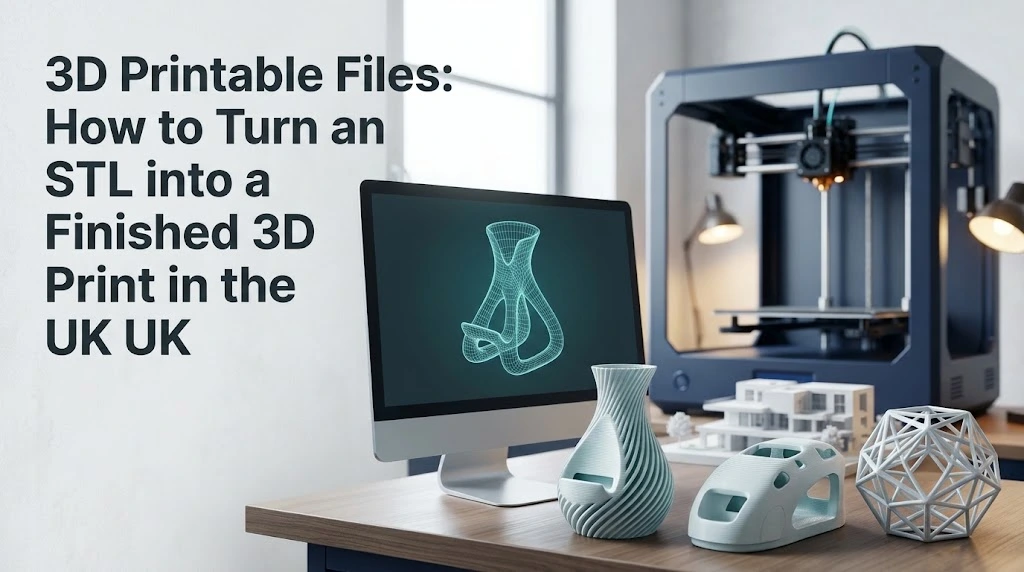
Have you found an interesting 3D model online but have no idea how to turn it into a real object? Perhaps you’ve downloaded an STL file for a phone stand, decorative piece, replacement component or personalised gift, only to discover that you need a 3D printer to make it.
The good news is that you don’t necessarily need to buy a printer or learn complicated software.
With the right 3D printable files, you can turn digital designs into physical products through a professional 3D printing service in the UK.
In this guide, we’ll explain what 3D printable files are, where to find them, how to check whether your design is suitable for printing and how to get your finished item delivered to your door.
What Are 3D Printable Files?
3D printable files are digital models containing the geometric information needed to produce three-dimensional objects.
Unlike a standard photograph or illustration, a 3D file represents an object with measurable dimensions, surfaces and shapes.
For example, you might download a 3D model of a desk organiser, a miniature building or a custom wall hook. Although you can view the design on a computer, it won’t become a physical product until it’s prepared and processed using 3D printing equipment.
Most printable models need to pass through specialised software known as a slicer. This software converts the digital geometry into instructions for a compatible 3D printer.
The printer then builds the object layer by layer, using materials such as PLA, PETG or photopolymer resin.
Common Types of 3D Printing Files
Several file formats are commonly used in 3D printing, and each serves a slightly different purpose.
| File format | Main purpose | Best suited for |
|---|---|---|
| STL | Stores the surface geometry of a model | General 3D printing |
| OBJ | Stores 3D geometry and can reference additional appearance information | Detailed models and digital designs |
| 3MF | Stores model information in a modern structured format | Printing workflows requiring richer model data |
| STEP | Stores editable CAD geometry | Engineering and product development |
STL is one of the most widely used formats for downloadable 3D printing designs.
However, STL files don’t inherently store physical units, so confirming dimensions is especially important before printing.
At PrintNests3D, customers can submit STL, OBJ or 3MF files for assessment through its custom printing service.
Where Can You Find 3D Printable Files?
You don’t need to design everything from scratch. Several online platforms allow users to discover downloadable 3D models for home accessories, hobby projects and practical products.
1. Thingiverse
Thingiverse is a popular library of community-created 3D models.
You can explore designs ranging from decorative objects and miniatures to practical household accessories.
Many models are free to download, although you should always check individual licensing terms before using or selling a design.
2. Printables
Printables offers an extensive collection of 3D printing designs.
Its categories include household accessories, storage solutions, decorative pieces, tools and hobby projects.
Project descriptions and photographs of completed prints can help you understand how a model might look in real life.
3. MyMiniFactory
MyMiniFactory is particularly useful for discovering artistic models, tabletop miniatures, figurines and collectable designs.
Both free and paid options may be available, depending on the creator.
4. Cults3D
Cults3D features printable files for accessories, decorations, miniatures and everyday objects.
Some designs can be downloaded for free, while others require payment.
Important: Downloading a model doesn’t automatically give you permission to reproduce it commercially. Check the creator’s licence, including whether third-party printing is permitted.
How to Turn an STL File into a Finished 3D Print
Turning a digital file into a physical product involves several stages.
Whether you plan to print at home or use a UK 3D printing service, understanding these steps can help you avoid costly mistakes.
Step 1: Find or Create Your 3D Model
Start by choosing a model that matches your needs.
Perhaps you’re looking for a personalised desk accessory, an unusual decorative object or a replacement component for something you already own.
Download the appropriate file format and keep any instructions supplied by the designer.
If you can’t find a suitable model, custom 3D printing providers may be able to review a sketch, reference image or project description instead.
Step 2: Check the Model’s Dimensions
Before submitting your file, verify the object’s size.
A model that looks perfect on your screen could turn out much larger or smaller than expected.
For example, a phone stand designed to be 120 mm tall should not accidentally be interpreted as 120 inches tall.
Always check the dimensions using the appropriate modelling or viewing software.
If you’re unsure, include your intended measurements when requesting a quote.
Step 3: Check Whether the Design Is Printable
Not every downloadable 3D model is immediately suitable for production.
Some designs contain problems that make printing difficult or impossible without adjustments.
Common issues include:
- Missing surfaces or gaps in the geometry.
- Walls that are too thin for the chosen printing process.
- Unsupported sections that may require additional structures.
- Incorrect dimensions or model scaling.
- Details too small to reproduce accurately.
- Separate components without sufficient fitting clearance.
A model can look visually complete while still containing technical problems.
Professional review is particularly useful for functional parts, complex shapes and projects requiring accurate measurements.
Step 4: Choose the Right 3D Printing Material
Material selection affects the appearance, durability and suitability of your finished product.
Three options commonly discussed in consumer 3D printing are PLA, PETG and resin.
PLA
PLA is often a sensible starting point for indoor decorative objects, display pieces and general-purpose products.
It can produce attractive results with a range of colours and finishes, although it may not be suitable for high-temperature environments.
PETG
PETG is commonly chosen when greater toughness and improved temperature resistance are required compared with standard PLA.
It can be useful for certain practical accessories and functional parts, provided the design is appropriate.
Resin
Resin printing is frequently used for models requiring fine details and smooth-looking surfaces, such as miniatures, detailed figurines and intricate decorative objects.
Material suitability depends on the exact resin formulation and the intended application.
No single material is best for every project.
If you’re unsure, explain how the object will be used and ask your printing provider for guidance.
Can You Use 3D Printable Files Without Owning a Printer?
Yes. You can use a professional 3D printing service to manufacture a suitable digital model.
This is particularly useful if you only need one or two items and don’t want the expense of purchasing equipment.
Owning a printer also involves learning software, choosing materials, maintaining equipment and dealing with unsuccessful prints.
For someone who simply wants a finished product, outsourcing may be the more convenient approach.
How Professional 3D Printing Works
The process generally involves submitting your file, confirming your requirements and receiving a quotation.
A printing provider assesses whether the design can be manufactured using available equipment and materials.
Once you approve the proposed scope, price and timing, the object can move into production.
After printing, it may require support removal, cleaning or other finishing work.
The finished product is then inspected, packed and dispatched.
Getting Your Model Printed with PrintNests3D
PrintNests3D offers custom 3D printing in the UK for suitable personalised items, prototypes, one-off projects and selected small batches.
You can submit an STL, OBJ or 3MF file, or share a sketch or reference image if you don’t already have a finished model.
The team reviews the design requirements, intended use, dimensions and material options before confirming what is practical.
Project details, pricing and expected timing are agreed before production begins.
This gives UK customers a way to turn digital designs into physical products without maintaining their own 3D printer.
What Can You Make with 3D Printable Files?
One of the biggest attractions of 3D printing is the variety of objects it can produce.
Here are several ideas worth exploring.
1. Phone Stands and Desk Accessories
A well-designed phone stand can improve the organisation of your workspace.
Other practical ideas include cable organisers, pen holders, headset stands and small desktop storage accessories.
2. Home Decorations
3D printing makes it possible to produce distinctive decorative objects.
Geometric sculptures, ornamental vases, abstract decorations and display pieces can add personality to modern interiors.
For products intended to hold liquids, make sure the design and material are suitable for that purpose.
3. Personalised Gifts
Custom models can incorporate names, dates, decorative shapes and other personal details.
These make thoughtful options for birthdays, anniversaries and special occasions.
4. Replacement Parts
Depending on the application, 3D printing can reproduce suitable knobs, brackets, clips, covers and other non-critical components.
However, safety-critical, heavily loaded, electrical and heat-exposed parts require careful engineering assessment and may not be appropriate for ordinary consumer printing.
5. Miniatures and Collectables
Detailed models, architectural miniatures, tabletop accessories and display figurines are popular uses of printable files.
Resin printing may offer advantages for projects with particularly fine features.
6. Product Prototypes
Small businesses and independent designers can use 3D printing to evaluate the size, shape and appearance of new products before considering larger-scale manufacturing.
A physical prototype can reveal issues that may not be obvious in a digital model.
How Much Does It Cost to Print an STL File in the UK?
There is no single fixed price for printing every STL file.
The cost depends on several factors, including the object’s size, material, geometry, printing time, finishing requirements and quantity.
A small, straightforward accessory may be much less expensive to produce than a large decorative object with intricate geometry.
Main Factors Affecting 3D Printing Costs
Object size and material usage: Larger models generally require more material, although internal structure and design complexity also matter.
Printing time: Detailed or difficult models may need longer production times.
Support structures: Overhanging features may require extra materials, printing time and post-processing.
Surface finish: Special finishing requirements can increase the amount of work involved.
Number of copies: Producing multiple identical parts can affect the cost per unit, depending on the production method.
Delivery: Packaging, shipping services and delivery requirements can influence the final amount payable.
For a more detailed breakdown, read our 3D Printing Cost UK: Complete 2026 Pricing Guide.
For an accurate price on your own project, request a quotation using your file and intended specifications.
Mistakes to Avoid When Downloading 3D Printable Files
Downloading a model is only the first stage. Some common mistakes can cause disappointing results.
Ignoring Licensing Restrictions
Check whether the designer allows personal use, commercial production or third-party manufacturing.
A free download is not necessarily a copyright-free design.
Choosing the Wrong Material
An object intended for indoor decoration may have different requirements from a component exposed to mechanical loads, moisture or elevated temperatures.
Choose materials according to their actual properties rather than appearance alone.
Forgetting to Confirm the Size
Always supply accurate measurements.
Even a small scaling error can make a practical component unusable.
Assuming Every Model Is Print-Ready
Some models are designed primarily for digital viewing rather than physical manufacturing.
These may require adjustments before printing.
Expecting an Identical Surface Finish
3D printed objects may show visible layer lines, support contact marks or other characteristics of the manufacturing process.
The final appearance depends on the printing technology, materials and finishing work.
How to Choose a Reliable 3D Printing Service in the UK
If you decide to outsource production, compare providers based on more than the initial quoted price.
Look for a service that clearly explains which files it accepts, what materials it offers and how it reviews custom requests.
It is also worth checking whether the provider confirms dimensions, discusses potential limitations and explains expected turnaround times.
A reliable provider should be able to clarify what is included in the quotation, particularly where a design needs changes or additional finishing.
PrintNests3D provides UK-based production with a review process for suitable custom projects. Customers can share files or ideas, discuss requirements and approve the agreed quotation before printing.
Frequently Asked Questions About 3D Printable Files
What is the best file format for 3D printing?
STL is widely supported and suitable for many printing projects. OBJ and 3MF are also useful, depending on the model and the printing workflow. The best choice depends on your design and the requirements of your printing service.
Can I print an STL file without a 3D printer?
Yes. A professional 3D printing provider can review your STL file and manufacture the object if it is technically suitable.
Are 3D printable files free?
Some are free, while others require a one-off purchase or another type of licence. Always review the downloading and usage conditions.
Can I convert an image into a 3D printable model?
In some cases, yes. However, a standard photograph does not contain all the geometry needed to produce an accurate 3D object. Creating a suitable model may require additional design work.
Can I change the size of an STL file?
Usually, yes. However, resizing also changes wall thicknesses, holes and other details. Functional parts should be checked carefully after scaling.
How long does 3D printing take in the UK?
Production times vary according to model complexity, size, material, quantity and a provider’s current workload. Delivery time is separate from manufacturing time.
Can I sell objects made from downloaded STL files?
Only if the relevant licence or other authorisation permits it. Some files are restricted to personal, non-commercial use.
Where can I get a custom STL file printed in the UK?
You can submit suitable STL files to a professional printing service such as PrintNests3D for review and a project-specific quotation.
Turn Your 3D Printable Files into Real Products
3D printable files open up creative possibilities for homeowners, hobbyists, designers and businesses.
From personalised decorations and practical accessories to collectables and early-stage prototypes, a suitable digital model can become a useful physical product.
You don’t need to own a printer to make that happen.
The important steps are choosing a suitable design, checking the dimensions, understanding the material options and working with a provider who can assess the requirements before production.
Ready to bring your idea to life?
Explore PrintNests3D's custom 3D printing service and submit your STL, OBJ or 3MF file for review. You can also share a sketch or reference image if you're starting with an idea rather than a completed model.
Explore custom designs