
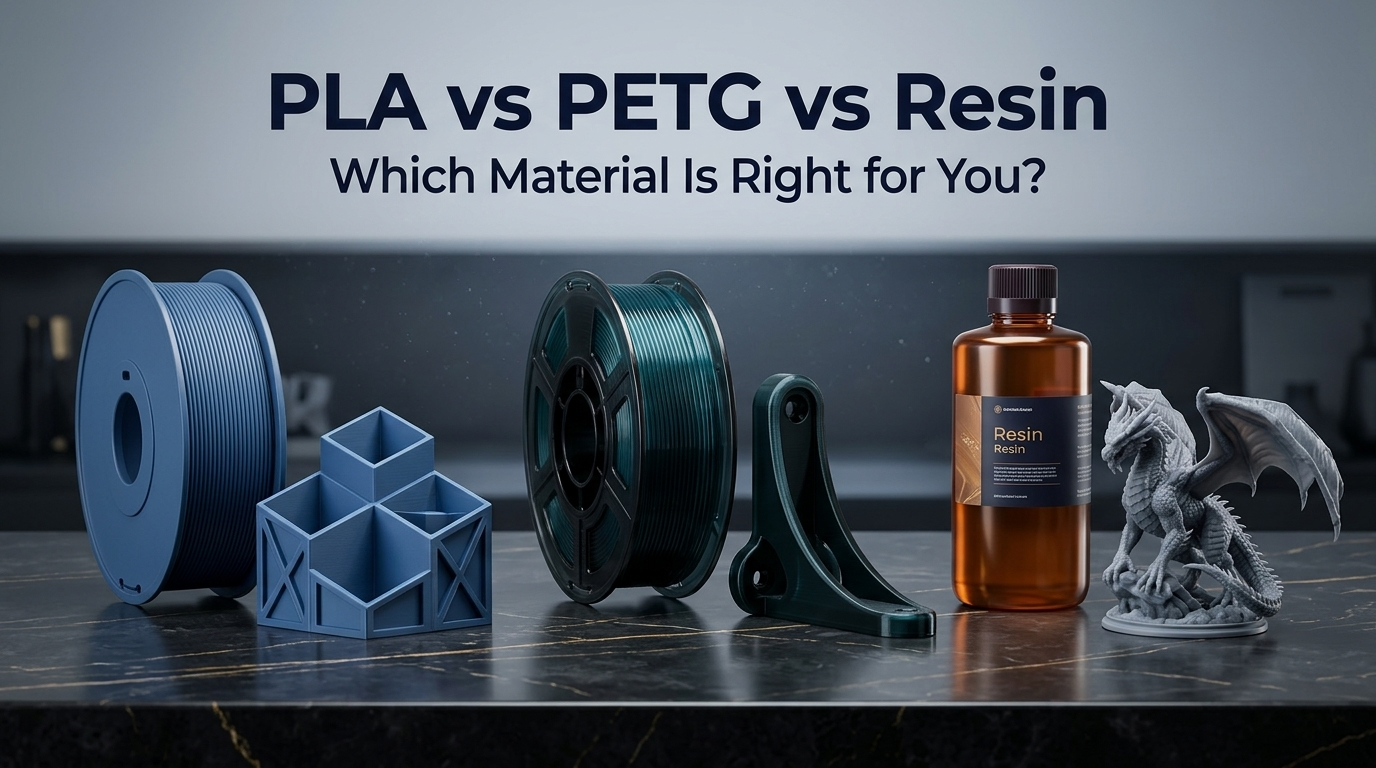
Planning to order a custom 3D printed product but unsure which material to choose? The difference between PLA, PETG and resin can affect how your finished item looks, feels and performs over time.
A decorative figurine sitting on a bookshelf doesn’t need the same strength as a functional wall bracket. Similarly, a detailed miniature with intricate patterns may require a different material from a simple desk organiser.
That’s where understanding PLA vs PETG vs resin becomes important.
These three popular 3D printing materials PLA vs PETG vs Resin offer different benefits in terms of durability, heat resistance, surface finish, flexibility and printing cost. Choosing the right material can help you avoid unnecessary expenses and ensure your product suits its intended purpose.
Whether you’re ordering a personalised gift, a replacement component or a prototype, this guide explains the differences between PLA, PETG and resin in straightforward terms.
We’ll also explore which material is best for common applications and how to choose the right option when ordering custom 3D printing in the UK.
PLA vs PETG vs Resin: What Is the Main Difference?
The main difference betweenPLA vs PETG vs Resin lies in their material properties and the way they are printed.
PLA is generally suitable for affordable decorative objects and everyday indoor products. PETG offers greater toughness and improved resistance to heat and moisture. Resin is commonly chosen for intricate models that require fine details and a smoother-looking finish.
PLA and PETG are usually printed using fused deposition modelling (FDM), which builds an object by depositing heated plastic filament in layers.
Resin printing uses liquid photopolymer materials that harden when exposed to controlled light through processes such as stereolithography (SLA) or masked stereolithography (MSLA).
Both technologies can produce attractive and functional objects, but they are suited to different requirements.
PLA vs PETG vs Resin: Quick Comparison
| Feature | PLA | PETG | Resin |
|---|---|---|---|
| Main advantage | Easy, economical printing | Toughness and durability | Fine detail and surface finish |
| Printing technology | FDM | FDM | SLA, MSLA or similar |
| Strength | Rigid but relatively brittle | Generally tough and impact-resistant | Depends on resin formulation |
| Heat resistance | Relatively low | Moderate | Varies considerably |
| Flexibility | Limited | More forgiving than PLA | Depends on resin type |
| Moisture resistance | Suitable for many indoor uses | Generally good | Material-dependent |
| Surface finish | Visible filament layers | Visible filament layers | Usually finer detail |
| Typical cost | Low | Low to moderate | Often moderate to high |
| Common uses | Decorations, organisers, prototypes | Brackets, holders, functional parts | Miniatures, detailed models, prototypes |
These characteristics are general guidelines. Actual performance depends on the manufacturer, material grade, printing settings, model orientation and finished part design.
For a broader technical comparison of filament properties, see Prusa’s official filament material guide.
What Is PLA in 3D Printing?
PLA, or polylactic acid, is one of the most widely used materials in desktop 3D printing.
It is a plant-derived thermoplastic commonly made using renewable feedstocks such as corn starch or sugarcane. PLA is popular because it is relatively easy to print, produces consistent results and is available in numerous colours and decorative finishes.
When comparing PLA vs PETG vs resin, PLA is often the most practical choice for objects that do not require high impact resistance or prolonged exposure to heat.
Benefits of PLA 3D Printing
PLA offers several advantages for everyday 3D printed products.
Attractive surface appearance
PLA can produce clean-looking objects with defined edges and detailed shapes. Its wide range of colours makes it particularly useful for decorative items.
Affordable production
PLA filament is generally economical, and its relatively straightforward printing requirements can help keep production costs manageable.
Good dimensional accuracy
PLA typically experiences relatively little warping during printing, making it useful for prototypes, models and components that need a consistent shape.
Wide range of finishes
PLA is available in matte, silk, metallic-effect and other decorative formulations, although the properties of speciality blends may differ from standard PLA.
What Is PLA Best Used For?
PLA is a popular material for:
- Personalised desk signs and nameplates
- Decorative sculptures and figurines
- Office organisers and stationery holders
- Indoor plant pot covers
- Display models and architectural concepts
- Custom gifts and keepsakes
- Simple prototypes and design samples
For example, if you’re looking for a stylish desktop pen holder or a personalised decorative item, PLA may provide the appearance you want without the additional cost of a more specialised material.
Our guide to 13 Useful Things to 3D Print for Your Home also explores practical product ideas where material selection can make a difference.
What Are the Disadvantages of PLA?
Despite its popularity, PLA has limitations.
Standard PLA can begin to soften at temperatures around 55–60°C, depending on the formulation and conditions. This makes it unsuitable for some objects left inside hot vehicles, near heat sources or under sustained loads in warm environments.
PLA is also relatively brittle compared with PETG. Thin clips, flexible joints and parts exposed to repeated impacts may crack or break.
Although PLA comes from renewable raw materials, it should not automatically be considered biodegradable in ordinary household or outdoor conditions. Effective composting generally requires specialised industrial processes and appropriate certification.
According to Prusa’s technical overview of PLA, the material is particularly suited to detailed models, figures and rapid prototypes that do not need demanding mechanical or temperature resistance.
Best choice: Select PLA for decorative indoor products, simple prototypes and everyday objects that will not experience significant mechanical stress or heat.
What Is PETG in 3D Printing?
PETG stands for polyethylene terephthalate glycol-modified.
Like PLA, PETG is used in filament-based 3D printing. However, its material properties make it more suitable for many practical objects that need increased durability.
In a PLA vs PETG vs resin comparison, PETG is often the middle ground between economical filament printing and more demanding functional applications.
PETG generally offers greater toughness than standard PLA, along with improved resistance to moisture and moderate temperatures.
Benefits of PETG 3D Printing
Better impact resistance
PETG is typically less brittle than PLA. It can absorb more impact and tolerate some deformation before breaking, depending on the design and printing conditions.
Improved heat resistance
PETG generally handles warmer environments better than standard PLA.
However, it still has temperature limits and should not be selected for high-temperature applications without checking the specific material specifications.
Good moisture resistance
PETG is useful for products exposed to humidity, occasional splashes or damp environments.
This does not mean every PETG 3D printed object will be watertight, as tiny gaps between printed layers can affect its ability to contain liquids.
Suitable for functional designs
PETG’s balance of rigidity and toughness makes it useful for holders, brackets and certain replacement components.
What Is PETG Best Used For?
Common PETG 3D printing applications include:
- Wall-mounted brackets and lightweight supports
- Workshop tool holders
- Replacement covers and protective housings
- Functional desk accessories
- Equipment organisers
- Custom mounting solutions
- Certain outdoor accessories
- Prototypes requiring improved impact resistance
Imagine you need a custom holder for tools in a workshop.
A PLA holder might be adequate for light use, but PETG may be preferable if the item will experience frequent handling, occasional knocks or exposure to moisture.
Prusa’s PETG material guide also identifies PETG as a suitable material for mechanical components, holders, clamps and various practical printed parts.
What Are the Disadvantages of PETG?
PETG is not necessarily the best material for every project.
It can be more difficult to print cleanly than PLA, particularly when the design contains small details, overhangs or narrow features.
A common printing issue is stringing, where thin strands of material appear between different parts of a model.
PETG can also require additional finishing work, depending on the shape and expected appearance.
Although PETG offers improved temperature tolerance, it is not appropriate for every high-heat or structural application.
Best choice: Choose PETG for functional 3D printed objects that need more toughness, moisture resistance or moderate heat tolerance than standard PLA can provide.
What Is Resin in 3D Printing?
Resin 3D printing uses a liquid photopolymer that solidifies when exposed to specific wavelengths of light.
Unlike PLA and PETG, which are generally printed from heated filament, resin printing creates objects by curing liquid material layer by layer.
The main advantage of resin is its ability to reproduce intricate shapes, fine textures and small details.
In the PLA vs PETG vs resin debate, resin is frequently the preferred choice for miniature models, detailed ornaments and designs where surface appearance matters more than straightforward filament printing.
Benefits of Resin 3D Printing
Excellent detail reproduction
Resin printing can capture intricate features that may be difficult to reproduce using ordinary FDM printing.
This makes it attractive for miniature characters, detailed sculptures and precision presentation models.
Smooth-looking surfaces
Resin printing often produces finer visible layer patterns than standard filament printing.
The result can appear smoother, although support marks and post-processing may still be visible.
Suitable for intricate designs
Fine textures, delicate patterns and complex surfaces can often be reproduced effectively using resin printing.
Specialised material options
Different resin formulations offer different properties. Some are designed for toughness, flexibility, higher temperatures or engineering applications.
However, these characteristics should never be assumed for ordinary general-purpose resin.
What Is Resin Best Used For?
Resin 3D printing is commonly used for:
- Detailed miniature figures
- Collectable characters and models
- Decorative sculptures
- Intricate architectural models
- Detailed product presentation prototypes
- Master patterns for suitable mould-making processes
- Small ornamental components
- Fine-detail display pieces
For example, a miniature dragon with detailed scales, facial features and decorative armour may benefit from resin printing.
A basic PLA print might reproduce the overall form, but resin may provide much clearer small features.
What Are the Disadvantages of Resin 3D Printing?
Resin printing involves additional production and finishing steps.
After printing, parts may need cleaning to remove uncured resin, followed by controlled post-curing to achieve the intended material properties.
These processes can increase production time and cost.
Standard resins may also be more brittle than PETG, particularly in thin sections or components exposed to repeated impacts.
The exact performance depends on the resin formulation.
For more technical detail, Formlabs explains how resin post-curing affects strength, stiffness and heat resistance.
Uncured resin requires careful handling, appropriate protective equipment and suitable disposal practices. The finished object’s suitability for a particular use depends on correct processing and the manufacturer’s material guidance.
Best choice: Select resin when you need intricate surface details, miniature designs or a refined finish that may be difficult to achieve through standard filament printing.
PLA vs PETG: Which Material Is Stronger?
One of the most common questions when comparing PLA vs PETG is which material offers greater strength.
The answer depends on what type of strength you mean.
PLA is relatively stiff, meaning it generally resists bending under ordinary conditions.
PETG is typically tougher and less brittle, allowing it to withstand certain impacts and deformation more effectively.
This distinction matters when selecting materials for functional products.
Consider two examples.
A rigid display stand that remains on a desk may work perfectly well in PLA.
A snap-fit accessory that needs to flex slightly during installation may be better suited to PETG.
However, the finished object’s geometry is just as important as the material.
A poorly designed PETG bracket can still break under load, while a carefully designed PLA component may perform well in an appropriate low-stress application.
Other factors affecting printed part strength include layer direction, wall thickness, infill, print temperature and the forces applied during use.
Verdict: PETG is generally the stronger choice when impact resistance and toughness are the main concerns. PLA remains suitable for many rigid, low-stress objects.
PLA vs Resin: Which Material Produces Better Detail?
When comparing PLA vs resin, surface finish and fine detail are often the deciding factors.
PLA can produce attractive models with good dimensional consistency. However, FDM printing deposits individual strands of melted plastic, which can leave visible layer lines.
Resin printing uses a different process and can achieve much smaller surface features.
This makes resin particularly effective for intricate designs.
For example, a geometric vase with simple shapes may look excellent when printed in PLA.
A small decorative figurine with facial expressions, textured clothing and delicate patterns may benefit from resin.
That doesn’t mean resin always produces the better final product.
For larger objects with relatively simple geometry, PLA may provide a practical, attractive result at a lower cost.
The difference becomes more noticeable when the design includes intricate details at a small scale.
Verdict: Resin is generally better for highly detailed miniatures and complex surfaces, while PLA is an economical choice for larger decorative models and everyday objects.
PETG vs Resin: Which Is Better for Functional 3D Printed Parts?
PETG vs resin is a slightly different comparison because the two materials can serve very different purposes.
PETG is a thermoplastic filament commonly used for brackets, holders, housings and other functional components.
Resin is a photopolymer material available in numerous formulations, ranging from decorative standard resins to specialised engineering grades.
For everyday functional items, PETG is often a practical starting point because of its toughness and resistance to moisture.
Resin may be more suitable when the part requires intricate small features or a specific specialised material property.
For instance, a workshop cable holder may be suitable for PETG.
A small demonstration component with delicate channels or intricate details may be more appropriate for resin.
However, standard resin should not automatically be considered suitable for demanding mechanical applications.
As explained in Formlabs’ guide to selecting 3D printing materials, different manufacturing processes and material formulations produce different mechanical characteristics.
Verdict: PETG is often better suited to ordinary functional accessories, while resin may be preferable for intricate prototypes or specialised applications where its particular properties are needed.
PLA vs PETG vs Resin: Which Material Is Best for Your Project?
The easiest way to choose between PLA, PETG and resin is to consider what the finished product will actually do.
A decorative product may prioritise colour and surface appearance.
A functional bracket may prioritise toughness and resistance to repeated handling.
A small miniature may require intricate detail above everything else.
Here are some common applications and the materials worth considering.
| 3D printed product | Suggested material | Main reason |
|---|---|---|
| Personalised nameplate | PLA | Attractive finish and economical production |
| Miniature figurine | Resin | Fine detail reproduction |
| Tool holder | PETG | Improved toughness |
| Desk organiser | PLA | Suitable for ordinary indoor use |
| Functional mounting bracket | PETG | Better impact resistance |
| Detailed decorative sculpture | Resin | Intricate surface detail |
| Indoor plant pot cover | PLA | Decorative appearance |
| Small presentation prototype | PLA or resin | Depends on detail requirements |
| Replacement housing | PETG | Functional durability |
| Collectable display model | Resin | Small intricate features |
These suggestions are starting points, not guarantees. Actual material selection should account for the size, geometry, mechanical loads and environment of the finished product.
Best Material for Home Decorations
PLA is often suitable for decorative home accessories such as display objects, desk organisers, nameplates and geometric ornaments.
If you’re ordering a large decorative object with a relatively simple shape, PLA may provide the best balance between appearance and cost.
For smaller ornamental pieces requiring intricate detail, resin may be preferable.
Best Material for Personalised 3D Printed Gifts
The right material depends on the design of the gift.
PLA can work well for personalised signs, decorative objects and display models.
Resin is often suitable for detailed figurines or decorative miniatures.
PETG may be worth considering for practical gifts that will experience frequent handling.
You can explore PrintNests3D’s custom designs for inspiration before submitting your own idea.
Best Material for Replacement Parts
PETG is a popular candidate for certain replacement housings, clips, brackets and lightweight functional components.
Its improved toughness can make it preferable to PLA in applications where the object experiences regular movement or occasional impact.
However, not every replacement component is suitable for 3D printing.
Parts associated with electrical safety, critical mechanical loads, high temperatures or injury prevention require appropriate engineering review and testing.
Best Material for Product Prototypes
PLA is often a sensible choice for early concept models.
If you simply need to check the appearance, proportions or basic fit of a design, PLA may be sufficient.
PETG may be useful when testing functional elements that require toughness.
Resin may be more suitable when the prototype includes intricate features or requires a particular surface finish.
For UK businesses exploring personalised products or early-stage concepts, PrintNests3D’s custom 3D printing service allows you to submit a design or explain your requirements before production.
How Does Heat Resistance Compare Between PLA, PETG and Resin?
Heat resistance can be one of the most important differences between PLA, PETG and resin.
Standard PLA has relatively limited heat tolerance and can begin to soften at temperatures around 55–60°C.
PETG generally offers better thermal performance and may be suitable for moderately warm environments where PLA would be less reliable.
Resin performance varies widely.
Some general-purpose resins have limited heat resistance, while specialised high-temperature resins are designed for more demanding conditions.
You should also consider whether the part will be carrying weight while exposed to heat.
A printed object may gradually deform under sustained stress even when the temperature is below its short-term failure point.
If you’re ordering a component for a warm environment, always describe the expected temperature and loading conditions.
A material selected for an indoor desk accessory may be inappropriate for an object kept inside a car during summer.
Is PLA, PETG or Resin Better for Outdoor Use?
Outdoor conditions introduce challenges that are easy to overlook.
Sunlight, rain, temperature changes and repeated exposure to moisture can all affect a 3D printed object.
When comparing PLA vs PETG vs resin for outdoor applications, PETG is often more suitable than ordinary PLA.
Its moisture resistance and improved heat tolerance make it useful for certain outdoor accessories.
However, PETG is not automatically suitable for permanent exposure to sunlight or severe weather.
Different PETG formulations can vary in UV resistance, and long-term conditions may require specialist materials.
PLA is generally better suited to indoor applications, particularly when prolonged heat and sunlight exposure are possible.
Resin suitability depends on the formulation. Some resins are intended for particular environmental conditions, while others may become brittle or discoloured with prolonged exposure.
For demanding outdoor products, alternatives such as ASA may also deserve consideration.
Before choosing a material, identify whether the product will experience direct sunlight, rain, temperature fluctuations or mechanical loading.
PLA vs PETG vs Resin: Which Is the Cheapest 3D Printing Material?
Cost is another important factor when choosing between PLA, PETG and resin.
PLA is generally one of the most economical materials for straightforward 3D printed objects.
PETG filament can be somewhat more expensive, depending on the manufacturer and formulation.
Resin printing may involve higher overall production costs because of specialised materials, support structures, cleaning, curing and finishing requirements.
However, material price alone does not determine the final cost of a 3D printed product.
What Affects the Cost of 3D Printing?
Several factors influence the price of custom 3D printing in the UK.
Product size: Larger designs generally require more material and printing time.
Design complexity: Intricate features may require additional supports, slower printing or more finishing work.
Material selection: PLA, PETG and resin involve different material and production costs.
Print orientation: How the object is positioned during printing can affect print time, support requirements and visible surface quality.
Finishing requirements: Sanding, cleaning, curing or other finishing processes may add to production costs.
Order quantity: Multiple items can affect preparation, material use and production efficiency.
For example, a simple PLA desk accessory may be relatively economical, while a detailed resin sculpture could involve additional processing.
On the other hand, a very large filament print may cost more than a small resin miniature.
The most useful way to assess cost is to share your model, preferred dimensions, quantity and intended use.
At PrintNests3D, customers can request a custom 3D printing quote and receive guidance on suitable production options.
Common Mistakes When Choosing Between PLA, PETG and Resin
Selecting a material based only on its price or popularity can lead to disappointing results.
Here are some common mistakes worth avoiding.
Choosing PLA for High-Temperature Applications
PLA can soften in warm conditions.
If an object will be kept near a heat source or inside a hot vehicle, its temperature exposure should be considered before selecting PLA.
Assuming PETG Is Unbreakable
PETG is generally tougher than standard PLA, but it can still crack, deform or fail.
Thin walls, poorly positioned layer lines and excessive loads can weaken a printed component.
Choosing Resin for Every Detailed Product
Resin is excellent for fine details, but not every project requires it.
For larger decorative objects with simpler geometry, PLA may provide an attractive finish at a lower overall cost.
Ignoring Print Orientation and Wall Thickness
Material selection is only one part of producing a reliable printed object.
Wall thickness, layer direction, internal structure and object geometry all influence the finished result.
Assuming All 3D Printing Materials Are Food-Safe
Neither PLA, PETG nor resin should automatically be considered suitable for direct food contact.
Food-contact suitability depends on the exact material formulation, manufacturing method, additives, surface finish and applicable regulations.
A material being used in conventional food packaging does not establish that a 3D printed version is appropriate for the same purpose.
Forgetting About the Intended Environment
A decorative product used indoors may need very different properties from an accessory exposed to moisture or sunlight.
Always describe where and how the object will be used.
How to Choose the Right 3D Printing Material in Five Steps
If you’re still undecided after comparing PLA vs PETG vs resin, the following process can help.
Step 1: Identify the Purpose of Your Item
Start by asking whether your product is primarily decorative, functional or a prototype.
For decorative items, PLA and resin may be suitable.
For functional objects, PETG may offer useful advantages.
Step 2: Consider the Expected Durability
Will the product remain on a shelf, or will it be handled every day?
If the item will experience regular impacts or mechanical stress, look beyond appearance and consider material toughness.
Step 3: Check the Environmental Conditions
Think about temperature, moisture and sunlight exposure.
A material suitable for an indoor ornament may not be suitable for an outdoor mounting component.
Step 4: Decide How Important the Surface Finish Is
If your design includes intricate patterns, miniature features or delicate details, resin may be worth considering.
If the design is relatively simple, PLA or PETG could provide a practical solution.
Step 5: Discuss Your Requirements Before Printing
You don’t need to make the final decision without help.
A custom 3D printing provider can review the model, intended use and available materials before recommending an appropriate production approach.
This is particularly useful if you’re unfamiliar with 3D printing materials or working with a design that has specific requirements.
How PrintNests3D Helps UK Customers Select 3D Printing Materials
Choosing between PLA, PETG and resin doesn’t have to be complicated.
At PrintNests3D, we provide custom 3D printing services for customers across the UK, including personalised designs, decorative products, prototypes and suitable functional objects.
Our available material options include PLA, PETG and resin, depending on the project.
Rather than expecting every customer to understand technical material specifications, we review the design and how the finished product will be used.
Share Your Design or Idea
You can submit an existing STL, OBJ or 3MF file for review.
If you don’t have a finished model, you can share a reference image, sketch or written description of your idea.
Explain How the Product Will Be Used
Tell us whether the item is intended for decoration, regular handling, prototyping or another practical purpose.
Include details about its dimensions, preferred appearance, expected environment and quantity.
Review Suitable Material Options
We consider the design requirements and discuss practical printing options.
The aim is to choose a material that makes sense for the object’s intended use rather than simply selecting the most expensive option.
Confirm Your Project Before Production
Once the requirements have been reviewed, the scope, pricing and timing can be agreed before printing begins.
Finished items are checked before dispatch to customers across the United Kingdom.
If you’re ready to explore a custom product, visit our UK custom 3D printing service and share your project requirements.
Frequently Asked Questions About PLA vs PETG vs Resin
Is PLA or PETG better for 3D printing?
PLA is often better for decorative objects, display models and simple indoor accessories because it is economical and produces attractive results. PETG is generally more suitable for functional parts that need additional toughness, moisture resistance or improved heat tolerance.
Is resin stronger than PLA?
Not necessarily. Standard resin can be relatively brittle, while specialised engineering resins may offer different strength or flexibility characteristics. PLA is relatively rigid, but the strength of any finished print also depends on the material formulation, geometry and printing process.
Which is better for miniatures, PLA or resin?
Resin is generally preferred for highly detailed miniatures because it can reproduce small surface features and intricate geometry. PLA may still be suitable for larger figures or models where extremely fine details are not essential.
What is the strongest material out of PLA, PETG and resin?
There is no single strongest option for every application. PLA offers stiffness, PETG generally provides greater toughness and impact resistance, and resin properties vary significantly by formulation. The right choice depends on the forces and conditions the printed object must withstand.
Is PETG more expensive than PLA?
PETG filament is often slightly more expensive than standard PLA, although prices vary by manufacturer and grade. The total printing cost also depends on design complexity, print time, finishing requirements and order quantity.
Is PLA suitable for outdoor use in the UK?
PLA can be used in some sheltered outdoor situations, but ordinary PLA is generally not the first choice for prolonged exposure to sunlight, elevated temperatures and changing weather. PETG or another outdoor-suitable material may be more appropriate depending on the conditions.
Can resin 3D prints break easily?
Some standard resins can be brittle, especially in thin sections or when exposed to impact. Specialised tough and flexible resin formulations behave differently. Choosing the appropriate resin and designing the object correctly are important for durability.
Does PETG last longer than PLA?
PETG may perform better than PLA in certain demanding conditions involving moisture, impact or moderate heat. However, actual lifespan depends on the object’s design, material grade, environmental exposure and frequency of use.
Which 3D printing material has the smoothest finish?
Resin printing typically produces finer surface details and less noticeable layer patterns than standard filament-based PLA or PETG printing. However, final appearance depends on print settings, supports and post-processing.
Can I order a custom 3D print without knowing which material I need?
Yes. With PrintNests3D’s custom 3D printing service, you can submit your design or explain your idea. The team can review your intended use and discuss suitable available materials before production.
Final Verdict: PLA vs PETG vs Resin
The best material for your 3D printed item among PLA vs PETG vs Resin depends on what you want to create and how you plan to use it.
If you’re comparing PLA vs PETG vs resin, remember these three key differences.
Choose PLA when you want an economical, attractive material for indoor decorations, simple prototypes or everyday display items.
Choose PETG when your product needs greater toughness, improved moisture resistance or better performance in moderately warm environments.
Choose resin when detailed appearance, intricate geometry and fine surface features matter most.
None of these materials is universally better than the others. Each has strengths and limitations, and the right selection comes down to your project’s requirements.
If you’re planning a personalised gift, decorative product, functional accessory or prototype, you don’t need to make the decision alone.
At PrintNests3D, we help customers across the UK explore suitable materials and turn their ideas into finished 3D printed products.
Ready to bring your idea to life?
Share your model, sketch or project description, and we'll help you explore the next steps.
Request a Custom 3D Printing Quote from PrintNests3D