
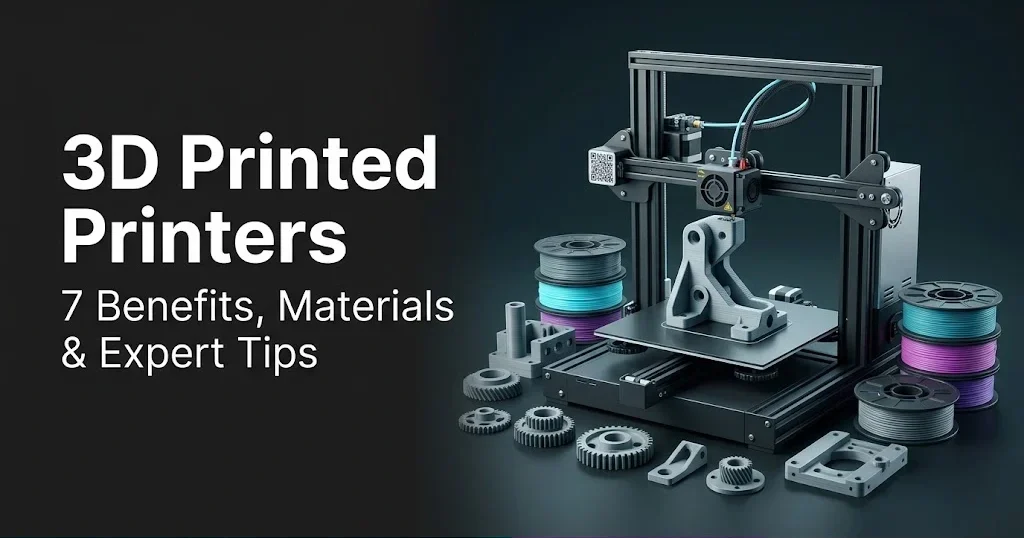
3D Printed Printers are changing how makers, engineers and hobbyists build, maintain and improve their machines. Instead of relying entirely on factory-manufactured components, enthusiasts can produce selected structural parts, brackets, mounts and accessories using another 3D printer.
This approach makes it easier to experiment with custom designs, replace certain damaged components and develop machines around specific requirements.
For beginners, the idea of printing parts for a printer might sound complicated. However, it is one of the principles that helped make desktop additive manufacturing more accessible.
In this guide, we explain how these machines work, which components can be manufactured, the best materials to consider and seven practical benefits. We also explore the costs, limitations and important safety considerations for anyone planning a DIY build in the UK.
What Are 3D Printed Printers?
A 3D printed printer is a machine constructed partly from components manufactured through additive manufacturing.
Unlike conventional consumer electronics, where most mechanical housings and brackets are mass-produced, certain printer designs use printable plastic parts that can be reproduced, modified or replaced.
It is important to understand that a printer cannot typically manufacture every component needed to build another functioning printer.
Electronic control boards, motors, power supplies, heating elements, bearings and metal fasteners must still be obtained separately.
The most common example comes from the RepRap project, which helped popularise the concept of desktop machines capable of producing many of their own plastic components.
The RepRap community introduced an open approach to printer development, encouraging users to share designs and improve existing machines.
This concept eventually influenced many commercially available 3D printers.
How Do 3D Printed Printers Work?
These machines generally operate using fused filament fabrication (FFF), also commonly called fused deposition modelling (FDM).
The basic printing process involves several stages:
- A digital design is created using CAD software or downloaded from a trusted model library.
- Slicing software divides the model into printable layers and generates machine instructions.
- Plastic filament is heated and extruded through a nozzle.
- The printer deposits material layer by layer to build the selected component.
- The completed part is inspected, fitted and assembled with the remaining hardware.
Once the machine has been assembled, it can manufacture suitable replacement parts, accessories and components for other projects.
This creates opportunities for ongoing modification without purchasing every plastic component from a manufacturer.
Suggested image placement 1
Image: A desktop FDM 3D printer producing a structural mounting bracket.
Image alt text: 3D Printed Printers creating replacement mechanical components
7 Amazing Benefits of 3D Printed Printers
Building a machine using printed components can offer several practical advantages, particularly for users who enjoy engineering, experimentation and hands-on learning.
1. Greater Design Flexibility
One significant advantage is the freedom to modify certain components.
A traditional printer may require manufacturer-specific replacement parts. With an open design, users can adjust compatible printable components to match their individual requirements.
For example, you might redesign a cable guide, reposition a sensor mount or improve the accessibility of an electronics enclosure.
This flexibility is especially useful for educational projects and small workshops.
2. More Affordable Replacement Parts
Some plastic components can be relatively inexpensive to reproduce when their design files are available.
Instead of ordering an entire replacement assembly, you may only need a small quantity of filament and access to a suitable machine.
However, printing your own parts is not always cheaper. Material consumption, failed prints, machine maintenance and labour should also be considered.
For simple components, especially those that are difficult to source, local production can still provide a practical alternative.
3. Easier Customisation and Upgrades
Owners often want to adapt their printers as their experience grows.
Possible modifications include improved filament guides, tool holders, cooling ducts, cable management systems and custom accessories.
Because certain components are printable, users can test design changes without investing in expensive manufacturing tools.
The ability to revise a part and produce another version makes experimentation considerably more accessible.
4. Practical Engineering Education
One of the strongest benefits of 3D Printed Printers is their educational value.
Building a machine introduces several important technical concepts, including mechanical alignment, motion systems, temperature control, electronics and computer-aided design.
Students and hobbyists can gain a better understanding of how individual components contribute to the performance of a complete machine.
These projects can also develop troubleshooting skills, patience and confidence when working with mechanical assemblies.
5. Faster Prototyping of Improvements
Rapid prototyping allows users to evaluate new ideas without waiting for traditional manufacturing.
A redesigned component can be modelled, printed, tested and adjusted over several iterations.
This is valuable when developing specialised accessories or checking whether a proposed design improvement functions correctly.
For businesses and inventors, the same process can support early product development.
If you need assistance producing suitable prototype components, explore the PrintNests3D custom 3D printing service.
6. Greater Repairability
Repairability is another important advantage.
When a manufacturer publishes printable spare parts, users may be able to replace damaged plastic components without discarding the entire machine.
This can be particularly useful for older printers when compatible replacement parts are no longer readily available.
The official Prusa printable parts guide demonstrates how downloadable component files support maintenance and upgrades. <Cite refs={[“turn206842search0″,”turn206842search1”]}/>
Repairing an existing machine may also reduce unnecessary waste, provided replacement parts are safe and suitable for the application.
7. A More Collaborative Maker Community
Open-source printer projects benefit from communities that share technical knowledge, models and practical improvements.
Users can learn from other builders, compare different approaches and contribute modifications to existing designs.
This collaborative environment can make complicated projects easier to understand, especially when comprehensive documentation is available.
However, community designs should still be assessed carefully. A popular downloadable model is not automatically safe, reliable or compatible with every machine.
Which Parts of a 3D Printer Can Be Printed?
Not every component is suitable for additive manufacturing.
Some parts are ideal for plastic printing, while others require metal, electronics or specialist manufacturing processes.
Understanding these differences is essential before beginning a printer-building project.
| Component | Can it be 3D printed? | Important consideration |
|---|---|---|
| Cable clips and guides | Yes | Check size and fit |
| Display housings | Usually | Allow access and ventilation |
| Filament guides | Yes | Avoid excessive friction |
| Fan ducts | Often | Use suitable heat-resistant material |
| Brackets and mounts | Sometimes | Check strength and loading |
| Mainboard electronics | No | Purchase compatible electronics |
| Stepper motors | No | Require manufactured motor assemblies |
| Heating elements | No | Must meet electrical and thermal requirements |
| Precision rods and bearings | Generally no | Manufactured parts provide better precision |
The table illustrates why most practical builds combine printed plastic parts with purchased mechanical and electronic components.
For critical parts, always follow the instructions provided by the printer manufacturer or trusted project designer.
Best Materials for 3D Printed Printers
Choosing the right material is essential because printer components experience different mechanical loads, operating temperatures and environmental conditions.
A material suitable for a decorative cover may not be appropriate for a component installed near a heated assembly.
PLA for Simple Accessories
Polylactic acid, commonly known as PLA, is widely used because it is relatively easy to print and provides good dimensional accuracy.
It can be suitable for accessories, prototypes and components installed away from high temperatures.
However, PLA may soften or deform when exposed to elevated temperatures, making it unsuitable for some structural or heat-adjacent applications.
PETG for Durable Components
PETG is often a practical choice for printer parts that require greater toughness and temperature resistance than standard PLA.
It offers useful durability for many brackets, housings and functional components.
Prusa recommends PETG for many of its printable printer parts, although some components require different materials. <Cite ref=”turn206842search0″/>
The appropriate choice ultimately depends on the part design and the conditions in which it operates.
ASA or ABS for Selected Heat-Resistant Parts
ASA and ABS are frequently considered for components that must tolerate higher operating temperatures.
They can be useful for certain fan ducts and printer accessories, but these materials require more careful temperature management during printing.
They may also release fumes and ultrafine particles, so appropriate ventilation and equipment controls are important.
For beginners, it is usually best to follow verified material recommendations instead of experimenting with critical printer components.
Suggested image placement 2
Image: PLA, PETG and ASA filament samples displayed beside finished mechanical parts.
Image alt text: Filament materials used to manufacture parts for 3D Printed Printers
How Much Does It Cost to Build a 3D Printed Printer in the UK?
The total cost depends on the machine’s design, print volume, electronics, motion system and quality of purchased components.
A basic DIY machine may require less expensive hardware than a larger enclosed printer designed for demanding materials.
However, printing certain components yourself does not eliminate the cost of motors, electronics, power supplies or the remaining mechanical hardware.
When preparing a budget, consider the following expenses:
- Filament required for structural parts and accessories.
- Stepper motors, belts, bearings and linear motion components.
- Controller boards, wiring and compatible power supplies.
- Hotend assemblies, print beds and temperature sensors.
- Tools, fasteners, shipping and replacement components.
- Additional material for failed prints or design revisions.
It is also worth considering the value of your time.
For someone who primarily wants to manufacture finished products, purchasing a complete printer may be more economical than designing and assembling one.
On the other hand, a DIY project can provide valuable engineering experience that extends beyond the initial cost.
How to Build 3D Printed Printers Safely
Before starting a DIY printer project, select a documented design that matches your technical experience.
Avoid combining unrelated components without confirming mechanical and electrical compatibility.
Start With a Proven Design
Choose a machine with clear assembly instructions, a compatible parts list and readily available documentation.
This reduces uncertainty when selecting electronics, fasteners and printed components.
Inspect Every Printed Component
Check the finished parts for cracks, warping, dimensional errors and weak layer adhesion.
A poorly printed bracket may affect alignment or become unreliable under load.
If a component supports a critical assembly, use the specified material, print settings and orientation.
Follow Electrical Safety Requirements
Heating systems, mains wiring and power supplies require particular attention.
Use correctly rated components, appropriate protective enclosures and suitable safety features.
Never treat printed plastic as a substitute for components that must meet electrical safety standards.
If you are unfamiliar with mains-powered equipment, seek assistance from a qualified professional.
Test Before Regular Operation
After assembly, verify movement, sensor operation, temperature readings and safety controls according to the documented procedure.
Begin with controlled test prints and monitor the machine closely.
Do not leave an untested DIY printer operating unattended.
Are 3D Printed Printers Better Than Ready-Made Machines?
The answer depends on what you want to achieve.
For hobbyists interested in engineering and modification, a partially printed machine can be an exciting and educational project.
For users who prioritise convenience, manufacturer support and predictable operation, a ready-made printer may be the more practical option.
| DIY printer build | Ready-made 3D printer |
|---|---|
| Greater potential for customisation | Faster initial setup |
| Useful hands-on learning | Generally easier for beginners |
| Assembly and calibration required | Usually preassembled or supplied as a kit |
| Repair options depend on documentation | Manufacturer-specific service and parts |
| Performance depends heavily on build quality | Performance depends on the purchased model |
Neither option is universally better.
Consider your budget, technical experience, available time and intended applications before making a decision.
When Should You Use a Professional 3D Printing Service?
Not everyone needs to purchase or assemble a printer to benefit from additive manufacturing.
If you only need a few prototypes, replacement parts or personalised products, outsourcing may be more convenient.
Professional printing services can be especially useful when a project requires careful material selection, finishing or dimensional review.
At PrintNests3D, we help customers across the UK explore suitable custom printing projects, including prototypes, decorative pieces, personalised items and practical components.
You can browse our 3D printed products collection for inspiration or submit a design through our custom printing page.
If you require a component for a printer, provide its dimensions, intended use, reference model and any applicable material requirements.
We can then review whether the requested part is suitable for our production capabilities. We do not recommend using an unverified print for a safety-critical application.
Frequently Asked Questions
Can a 3D printer print another 3D printer?
A 3D printer can manufacture many plastic components needed for another printer, but it cannot generally produce a complete working machine independently. Motors, electronics, heating systems and other hardware still need to be supplied separately.
Are 3D Printed Printers suitable for beginners?
They can be suitable for motivated beginners who follow well-documented designs. However, building a printer requires mechanical assembly, calibration and an understanding of basic safety precautions.
A ready-made printer may be easier for someone with no previous experience.
Which filament is best for printer replacement parts?
PETG is commonly used for many functional printer components. However, the best material depends on the required strength, temperature exposure and manufacturer recommendations.
Can I order custom printer components in the UK?
Yes. Some printing services can manufacture suitable custom parts from supplied STL, OBJ or 3MF files.
PrintNests3D accepts custom project enquiries and reviews the design requirements before confirming whether production is appropriate.
Is it cheaper to build a printer from printed parts?
Not necessarily. Savings depend on the design, availability of hardware, material costs and assembly time.
For some users, a complete printer offers better overall value.
Final Thoughts
3D Printed Printers demonstrate one of the most interesting possibilities of additive manufacturing: using a machine to help create, repair or improve another machine.
From accessible replacement parts to custom mechanical designs, this approach gives makers more control over how their equipment develops.
The greatest advantages come from choosing reliable designs, suitable materials and carefully tested components.
Whether you want to build your first machine, improve an existing printer or explore a custom project, understanding the capabilities and limitations of additive manufacturing is an excellent starting point.
Have something in mind you'd love to bring to life?
At PrintNests3D, we help turn suitable designs, prototypes and creative ideas into finished products for customers across the United Kingdom.
Explore custom designs